
Give your CIPA the power of ETFs
Designed for company directors, Easyvest’s CIPA combines ETF-based index investing, full transparency, and lower annual fees ranging from 0,9% to 1,5%. An approach we have applied to CIPA management since 2017. Whether you want to start a new CIPA or transfer existing pension reserves, invest your pension capital in ETFs and follow the market rather than try to beat it.

Easyvest, awarded three times “Best in Test” by Test Achats in the robo-advisors category (2021, 2023 and 2025).
How much could your CIPA be worth at retirement?
Your salary determines how much you can invest in your CIPA each year. For example, with an annual salary of 50.000€, you can contribute up to 6.709€.
Find your maximum contribution in seconds, see how much capital you could build by retirement with an Easyvest CIPA, and compare it with the projected capital of a Class 21 or Class 23 CIPA.
Net capital at 67, same gross contributions
| Product | Entry fee |
Gross expected return |
Annual fee |
Net expected return |
Net at 67 |
|---|---|---|---|---|---|
| Class 21 | 2,61% | 2,29% | 0,05% | 2,24% | – |
| Class 23 | 2,07% | 5,25% | 2,36% | 2,89% | – |
| Easyvest CIPA | – | – | 0,90% – 1,50% | – | – |
Indicative projection, not guaranteed. The Easyvest amount, gross expected return and annual fee are the calculator’s above, for the chosen risk profile; the return and fee are averages over the period, as the share of equities falls when retirement approaches. The Class 21 and Class 23 amounts are calculated directly, with the same premiums, paid at the same pace and over the same period as in the calculator, less the 4,4% premium tax and the entry fee, compounded at the net expected return (gross return less the annual fee), then less 15,85% tax and contributions on the capital at retirement, as in the calculator. Past returns do not guarantee future returns.
Sources: weighted average entry and recurring costs of pension commitments for company directors (“LPCDE/WAPBL”) with insurance companies, FSMA, costs in the second and third pension pillars: 2024 update, September 2026, 2024 data, p. 2 and 5. Class 23 annual fees include those of the underlying funds. Expected gross returns of the classes: FSMA, expected returns and parameters for calculating the supplementary pension benefit, 2027 pension statement, most realistic scenario; for Class 23, a portfolio with 40% to 60% fixed income.

Why choose a CIPA at Easyvest?
Invest in ETFs for your pension
Forget the limits of guaranteed returns. Grow your capital through global ETFs.
Protect more than just your retirement
Choose guarantees in case of death or work incapacity (guaranteed income and contribution exemption).
Give new momentum to your existing capital
Transfer existing CIPA reserves to Easyvest.
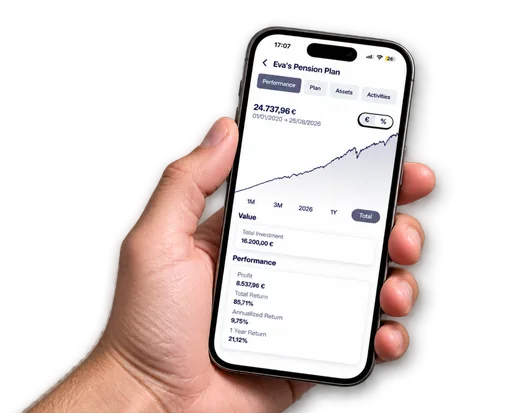
Gather all your pension data
Centralize all your plans in one app and compare your estimated pension with your desired retirement income.
Deduct 100% of your contributions
Reduce your company’s taxable income by deducting 100% of your contributions while building your pension.
Benefit from continuous 80% rule optimization
Get your maximum tax-deductible amount recalculated each year based on your situation.
A single management fee, all included
Our fees are deducted directly from your pension reserves and decrease as your managed balance grows.
| Assets managed | Fees |
|---|---|
| Up to 24.999€ | 1,50% / year incl. VAT |
| 25.000€ – 49.999€ | 1,40% / year incl. VAT |
| 50.000€ – 99.999€ | 1,25% / year incl. VAT |
| 100.000€ – 249.999€ | 1,10% / year incl. VAT |
| 250.000€ – 999.999€ | 1,00% / year incl. VAT |
| 1.000.000€ – 2.499.999€ | 0,95% / year incl. VAT |
| More than 2.500.000€ | 0,90% / year incl. VAT |
Discover past returns based on your profile
With ETFs, we replicate the performance of the global stock market and the European bond market to maximize your long-term returns. By choosing an ETF pension plan, you benefit from market returns. Here is our net performance history after fees.
FAQ about CIPA
Join 6.397 satisfied customers
We already manage €477 million for them.

I have an investment account where I add money on a regular basis to buy a house in 5 years.
Alexia Z., 28 yo

Company director, I plan my pension with tax efficient CIPA and an investment account.
David M., 37 yo

We have a joint account aiming at generating an automatic annuity while preserving our capital.
Elisabeth & Pierre B., 66 yo

I have a family investment account used to progressively pass on my estate to my children.
Michel R., 68 yo
Articles & videos
What is an ETF or "tracker"?
A tracker or index fund is an investment fund of which the strategy is to replicate or “track” the performance of a financial index. It differs from traditional investment funds in its passive approach that drastically reduces costs and avoids investment managers’ mistakes. Most trackers can be bought on a stock exchange all day long. These are referred to as Exchange Traded Funds or ETFs.
In 2023, investors took advantage of the market rebound thanks to ETFs
Index-based approaches have empowered investors to capitalize on the market rebound. This is the key takeaway from our performance analysis conducted at the end of August 2023, which once again positions Easyvest's recommended index strategy at the top of the rankings.
Belgian banks are 5 times more expensive than easyvest
Getting an extensive view of the fees charged on your investments turns out to be very complex and painful. Indeed, fees are poorly or not communicated by financial advisors, fragmented and spread over several reports, or simply hidden when regulation allows it. Easyvest strives here to shed light on the foggy fees of Belgian banks’ funds.